
Enum generation
Watch the Enums video on YouTube.
Enum values are often stored and maintained both in the database and in code, so every change has to be made twice to keep them in sync. PLINQO turns a table of data into an enum: you define which tables are enum tables, and which columns hold each value's name and description. Your enums are then maintained in one place.
To choose the enum tables and columns, set the EnumList, NameColumn and DescriptionColumm properties of the DBML template.
For example, PLINQO turns this Priority table:
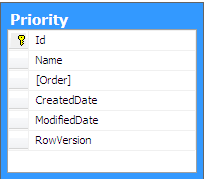
into this enum:
[DataContract]
public enum Priority : int
{
    [EnumMember]
    High = 1,
    [EnumMember]
    Normal = 2,
    [EnumMember]
    Low = 3,
}